
Calculus I
Published:
Teaching Semesters
Course Specification (Official)
This is the official course description. Please note that some of the information and requirements stated herein may not reflect my personal views.
Acknowledgement
I gratefully acknowledge Pearson for kindly providing me with complimentary sample copies of their textbooks for my teaching. I appreciate their trust and support. These resources have informed the development of some of my personal teaching materials below.
Personal Teaching Materials & Resources
Supplementary Notes on Textbooks and References
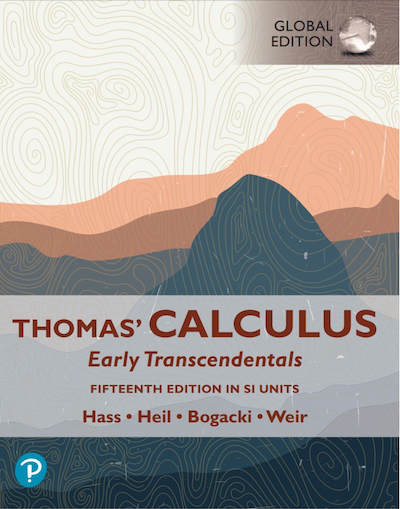
Textbook: Thomas’s Calculus
- The 12th–15th editions are all acceptable for this course. The mathematical content is largely consistent across these editions, although the topic order and chapter numbering may differ.
- The 14th edition is available in a relatively inexpensive reprinted version and is generally the most cost-effective choice.
- The 15th edition is the latest edition.
- The available Chinese translation is based on the 10th edition. It may be used for supplementary reference, but it is not recommended as the primary textbook for this course.
Reference
- For more reference recommendations, check out my Study Resources & Advice page.
Course Sequence
- The course sequence primarily follows the standard organization of the 12th edition, in which exponential and logarithmic functions are introduced later.
- Later editions generally use an Early Transcendentals organization, so exponential and logarithmic functions may appear earlier in the textbook.
- Consequently, the order of topics and chapter numbers in your textbook may not match the lecture sequence.
- Please follow the course outline, lecture slides, rather than the table of contents of a particular textbook edition.
- Assignments and examinations are based on the material covered in lectures, not on the chapter order of a particular textbook edition.
Personal Slides
This version was carefully adapted for my actual lectures, refined to reflect my teaching style and the needs of my students. The modifications include reworded explanations, added examples, exercises, and annotated notes to support classroom use. Copyright © Xiaozhou Li — CC BY-NC-ND 4.0
Note: Minor updates or in-class adjustments may not be reflected here in real time; slides are usually updated after each chapter is completed.
Course Overview Slide
- Chapter 1. Functions Slide, Lecture Note
- 1.1 Functions and Their Graphs
- 1.2 Combining Functions; Shifting and Scaling Graphs
- 1.3 Trigonometric Functions
- 1.4* Graphing with Software
- Chapter 2. Limits and Continuity Slide, Lecture Note
- 2.1 Rates of Change and Tangents to Curves
- 2.2 Limit of a Function and Limit Laws
- 2.3 The Precise Definition of a Limit
- 2.4 One-Sided Limits
- 2.5 Continuity
- 2.6 Limits Involving Infinity; Asymptotes of Graphs
- Chapter 3. Differentiation Slide, Lecture Note
- 3.1 Tangents and the Derivative at a Point
- 3.2 The Derivative as a Function
- 3.3 Differentiation Rules
- 3.4 The Derivative as a Rate of Change
- 3.5 Derivatives of Trigonometric Functions
- 3.6 The Chain Rule
- 3.7 Implicit Differentiation
- 3.8 Related Rates
- 3.9 Linearization and Differentials
- Chapter 4. Applications of Derivatives Slide, Lecture Note
- 4.1 Extreme Values of Functions
- 4.2 The Mean Value Theorem
- 4.3 Monotonic Functions and the First Derivative Test
- 4.4 Concavity and Curve Sketching
- 4.5 Applied Optimization
- 4.6 Newton’s Method
- 4.7 Antiderivatives
- Chapter 5. Integration Slide, Lecture Note
- 5.1 Area and Estimating with Finite Sums
- 5.2 Sigma Notation and Limits of Finite Sums
- 5.3 The Definite Integral
- 5.4 The Fundamental Theorem of Calculus
- 5.5 Indefinite Integrals and the Substitution Method
- 5.6 Definite Integral Substitutions and the Area Between Curves
- Chapter 6. Applications of Definite Integrals Slide, Lecture Note
- 6.1 Volumes Using Cross-Sections
- 6.2 Volumes Using Cylindrical Shells
- 6.3 Arc Length
- 6.4 Areas of Surfaces of Revolution
Chapter 7. Transcendental Functions Slide
Chapter 8. Techniques of Integration Slide
- Chapter 9. Ordinary Differential Equations Slide
Supplementary Learning Materials
微积分中英名词对照:源自《托马斯微积分第10版》(中文翻译版)附录,仅作课程教学辅助,若涉侵权请联系本人删除。百度网盘,OneDrive.
Problem Sets: A curated collection of problems from my courses, designed to deepen your understanding and sharpen your problem-solving skills.
- Some Course-Specific References:
- Additional Resources: For general study tips, further course-specific advice, and academic guidance, see my Study Resources & Advice.