
Recovering More from Numerical Simulations
Can We Recover More from a Computation That Has Already Been Done?
A Simple Case
Consider a simple approximation problem. A cubic function is represented by its piecewise linear projection on a given mesh. As the figure shows, the resulting approximation captures the overall behavior of the function, but it does not reproduce it accurately everywhere.
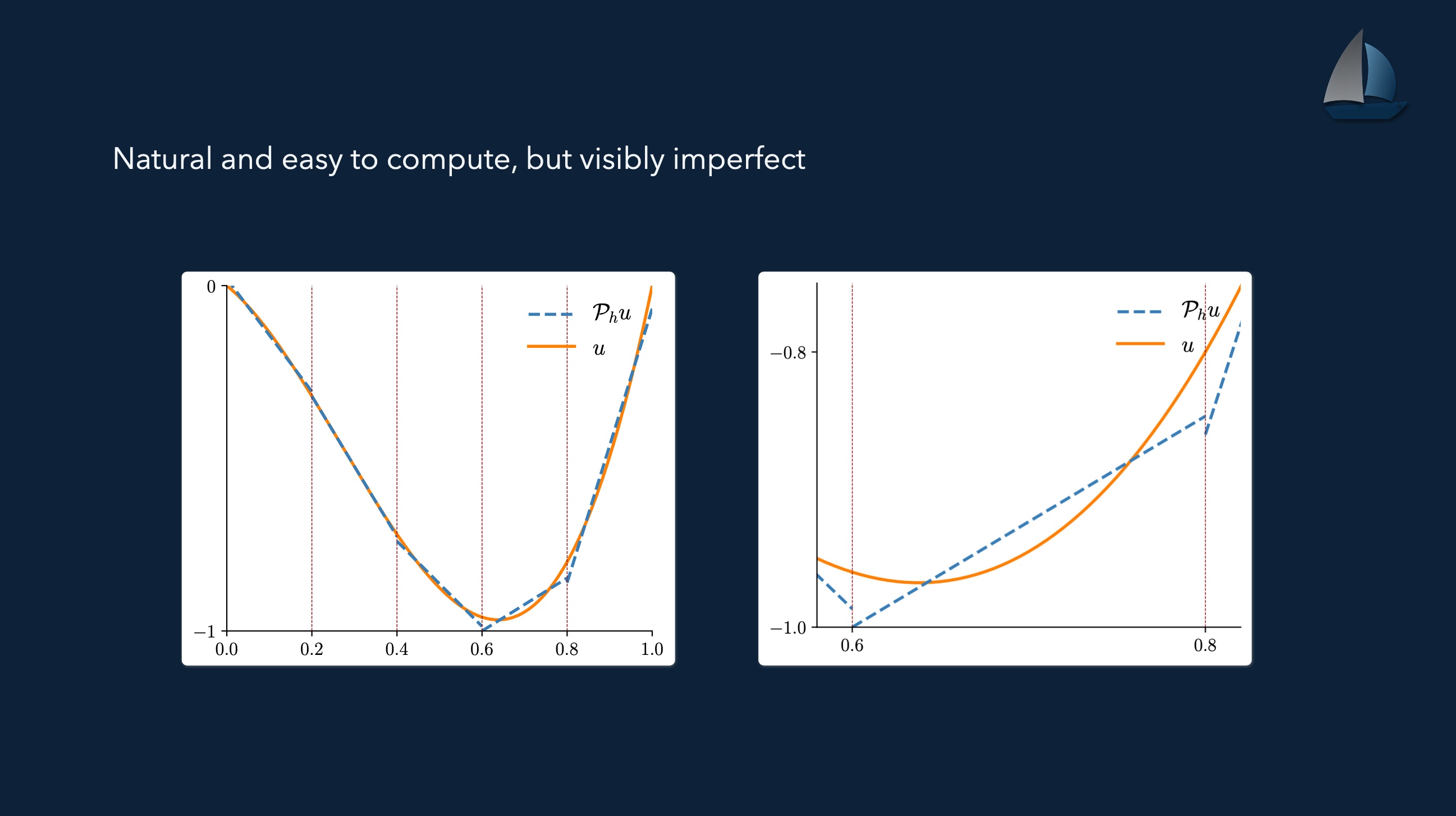
The usual way to obtain a better result would be to refine the mesh, increase the approximation order, or repeat the computation using a more accurate method. But suppose that only the existing approximation is available for further use—or that recomputation, although possible, would incur substantial additional cost. Is the visible piecewise linear representation all that remains, or does the computed approximation retain useful information that has not yet been extracted?
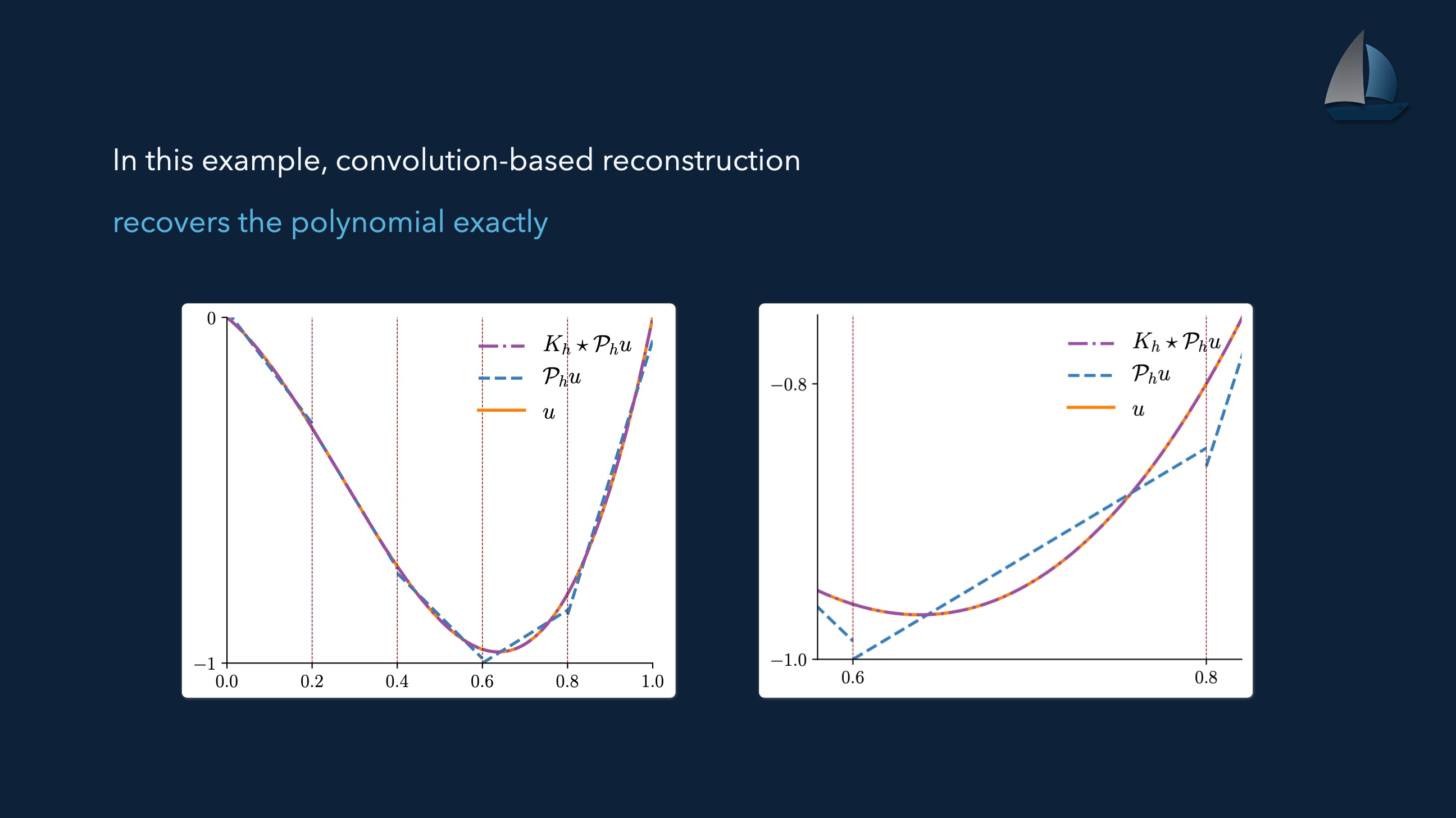
In this carefully structured example, an appropriately designed convolution filter recovers the original polynomial exactly from its low-order projection. The filter does not have access to the original function, nor does it repeat the projection on a finer mesh or in a higher-order space.
This does not mean that post-processing creates information from nothing, or that exact recovery is generally possible. Rather, the example demonstrates a more limited but important point:
A numerical approximation may retain information that is not immediately visible in its raw representation.
Whether that information can be recovered depends on the structure of the discretization error and on whether the reconstruction is properly matched to it.
Why Recovery Is Possible
Numerical errors are not always random or unstructured. Their patterns can be shaped by the approximation space, mesh, numerical fluxes, governing equations, and regularity of the underlying solution. Consequently, an approximation that appears only moderately accurate pointwise may represent certain averages, moments, locations, or combinations of the solution much more accurately than its raw form suggests.
Superconvergence is a particularly strong manifestation of this phenomenon. For some numerical methods, higher accuracy emerges at selected points, in particular projections, or in weak and averaged measures, even though the approximation does not achieve that accuracy everywhere. Rigorous analysis can identify where this additional accuracy resides, how it depends on the numerical method and the problem, and under what conditions it survives.
error pattern demonstration
From the perspective of reconstruction, these properties are valuable not merely because they produce a higher convergence rate in a theorem. They indicate that part of the discretization error is organized rather than arbitrary.
A suitable post-processing operation may combine information distributed across neighboring elements and convert weak, local, or otherwise hidden accuracy into a more accurate representation or output.
From Error Structure to Reconstruction
My research investigates when recoverable error structures arise in numerical solutions of PDEs, how they can be characterized through superconvergence analysis, and how reconstruction and post-processing can turn them into improved outputs. A central tool in this work is SIAC filtering, which uses carefully designed convolution kernels to combine information from the existing numerical solution.
The reconstruction is non-intrusive: it is applied after the original solution has been computed and does not require changes to the spatial discretization, solver, or time-integration scheme. This makes it potentially useful when the underlying simulation code is mature, externally maintained, difficult to modify, or expensive to rerun at higher resolution.
SIAC filtering is not treated as an end in itself, nor is exact polynomial reproduction the objective in every problem. It provides a mathematically analyzable framework for asking a broader question:
What information can be recovered from an existing approximation, for which outputs, under what assumptions, and at what additional cost?
What Counts as an Improvement?
In applications, greater accuracy everywhere is rarely the only objective. What matters may instead be a particular quantity of interest (QoI): a waveform recorded at a sensor, phase or arrival time in wave propagation, peak amplitude, an integrated response, or another output tied directly to the scientific or engineering task.
The purpose of reconstruction is therefore not simply to produce a smoother solution or to demonstrate a higher formal convergence order. It is to determine whether recoverable error structure can be used to improve a specified quantity of interest in a reliable and practically meaningful way. In some settings, SIAC filtering may produce a substantial improvement; in others, the relevant structure may be absent, disrupted by boundaries or irregularity, or too costly to exploit.
An output enhancement should consequently be assessed along several dimensions: the improvement in the target quantity, the assumptions and range of validity, the added computational, communication, storage, and implementation costs, and the comparison with alternatives such as mesh refinement, higher-order approximation, or recomputation. A method is valuable not merely when it can be proved to increase formal accuracy, but when the resulting improvement is relevant to the target output, reliable within a clearly stated range of validity, and worth its total cost.
The central question is not only whether more accuracy can be recovered, but whether the recovered accuracy improves the output that matters—and whether that improvement is worth paying for.